


🎦 Mentoring in Turbulent times
There is a lot of change ongoing at the moment. It is even more important than ever to provide support to those effected by Covid-19. We have created this article and the accompanying video to support mentoring in turbulent times. The content is particularly relevant as we live through the Covid-19 pandemic. However, it is also relevant to other periods of immense turbulence post this pandemic.
Watch the video or follow the content below (or turn on subtitles)
First look after yourself
When mentoring in times of turbulence, the first thing you must do before supporting other people is to look after yourself. Making time for your own mental self-care, physical exercise and being aware of your own feelings is absolutely critical. Developing your own support and stress reduction techniques and utilising a good friend, your partner or your own coach or mentor to talk things through with, is very important.
It is key to understand what emotions you are experiencing before you try and help your mentee to understand their own. It is also important to acknowledge the anxiety or fears you may be feeling currently, how to regulate these feelings and to manage and find meaning in them.
The Grief Cycle
We are all going through the Grief Cycle as we experience turbulent times.
This model was developed originally by Elisabeth Kubler-Ross to describe the process of grief when someone dies. However, it is a useful framework when we experience loss of different types. Some people will be affected more than others by grief. We sense and feel the world has changed, some of these changes may be temporary, some may be more long-lasting. Perhaps our working lives are affected, or we are unable to travel or have other restrictions imposed upon us. The absence of normality, fear of economic, social and political consequences and perhaps the loss of connection with other people is impacting us. We feel both grief for our losses as things in our lives change and are different, but also anticipatory grief, or the fear created by the uncertainty of our futures and our imagination of what can happen.
Understanding the Grief Cycle gives us a framework to both support our own understanding of our emotions at this time, but also to help with conversations with our mentees.
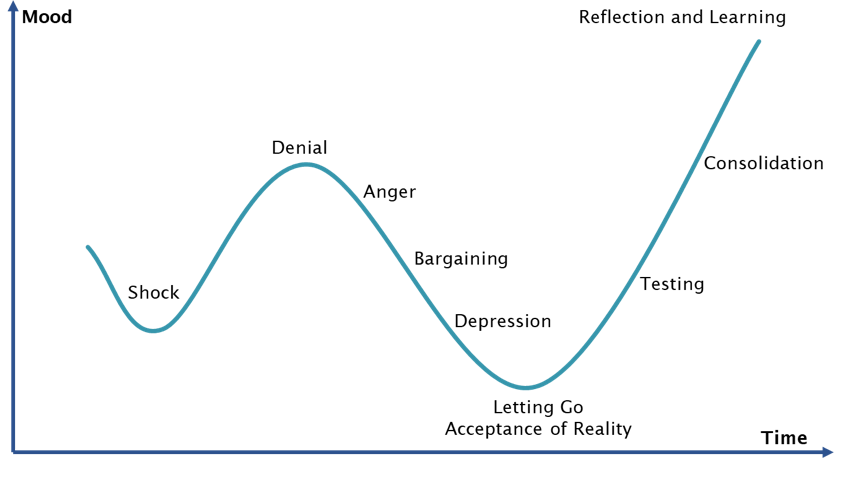
Denial is the first stage of the cycle. In this stage we often feel overwhelmed by the turbulent times we are living through and to protect ourselves, we simply get on with our lives and being in shock and denial help us to cope and make survival possible. Over time many of the feelings individuals are seeking to submerge begin to surface and they can begin to feel angry.
Anger can become the focus or connection to hold onto when you are feeling numb and lost during turbulence. There are many other emotions that people feel at this time, but anger is generally the one that most people recognise and are used to managing and suppressing.
Anger tends to evolve into a stage of bargaining. In our context we can translate this as a wish to make a deal, that our lives return back to how they were before the turbulence.
After bargaining we begin to move into the present and this can be when we feel very depressed about what has been lost. This is a very normal reaction. Feeling empty and low and mourning the loss of what has gone before, is a stage that occurs when we are living through immense change and turbulence.
Finally, we move into the stage of acceptance. This is about accepting a new permanent reality. We may not like what life looks like, but we accept this is the new ‘normal’ we have to live with. We have to readjust, reorganise and move on.
We do not move through these stages in a linear fashion. We may feel one, or another and then return back again to the first one. In a period of great turbulence, it is highly likely that normal life will change so it is very different and understanding these emotions your mentee may be feeling will help them to move forward.
Discuss and explore feelings
It is important to give resonance to the emotions your mentee is going through: Ask them directly about their feelings and the concerns or challenges behind these feelings, acknowledge that all these are absolutely normal for all human beings. Ask questions to let the mentee explore their feelings, such as ‘How does this situation make you feel’?
Develop resilience
Developing resilience and optimism in these turbulent times is important. However, there are several key areas where mentors can really support their mentees through helping to develop the new attitudes, needs and behaviours required to thrive going forward.
We can all experience fear, however much we try and put things into perspective. For example, the Covid-19 pandemic is on a different scale to anything we have known in our life-time and most people feel quite powerless. Our immediate reaction to a turbulent event such as the pandemic is one of being scared. Without emotional self-regulation this feeling can be denied or can turn quickly to fear. However, fear is a state of being, an emotion, a choice, one that can paralyse us if we allow it to. We can’t avoid being scared, but we can choose to self-regulate our emotions and choose not to be afraid. Reframing the situation in our mind is a way to counteract our fear.
Discuss fear
Mentors can support their mentees when discussing fear in their conversations:
- By stimulating and encouraging the desire to learn, particularly the growth of self-awareness any time of crisis, but also how learning generally can help to alleviate the feelings of fear.
- By demonstrating love. Perhaps more difficult in a working context, but by exhibiting compassionate empathy, practising deep listening and paying beautiful attention to their mentee. Compassionate empathy is a way for the mentor to show empathy in a way where they demonstrate they understand the mentee and want to support them.
- Offering mindfulness through active “slow listening”, integrating moments of silence into the dialogue and supporting the mentee to remain in the present moment.
Creating adaptive capacity, developing innovation
Mentors need to support the development of adaptive capacity in their mentee during times of turbulence. Resilience describes the degree of shock or change that can be tolerated during a crisis. This is important, but it is the extent of an individual’s adaptive capacity that is more critical. How an individual adjusts to the potential damage of any crisis but also flexes to take advantage of opportunities or responds positively to the consequences.
Develop new thinking
The capacity to evolve and develop new thinking will be crucial in creating new opportunities and developing new pathways of growth to allow a green and just recovery in the global chaos and economic downturn which turbulent times can create. Supporting mentees to harness a creative mindset to be able to strategise across the various dimensions of any crisis will enable organisations and the people within them, to thrive.
Create reflective space
Part of the role of the mentor in supporting the development of adaptive capacity is to create the reflective space required to produce innovative and creative ideas to successfully move through this period.
Unfortunately, one impact of living in any turbulent times, is to suffer from a continual attack on our nervous system from our ‘fight or flight’ reaction to high pressurised situations. What a mentor can do is to engage the parasympathetic system (the ‘rest and digest’ system) and help individuals to relax and reflect. Creative insight can be facilitated by the mentor through the simple use of active listening skills and questioning techniques in an environment of trust and relaxation. By simply supporting the framing of the challenge, helping the mentee to gather the needed selected data and information together and supporting a relaxed state, the ideas will flow from the mentee.
There is more information and tangible tools, techniques, resources and support in mentoring in times of turbulence.
Download a PDF of this content, or use the Print this page in the footer.


Leave a Reply
Want to join the discussion?Feel free to contribute!