

Listening Skills in Mentoring
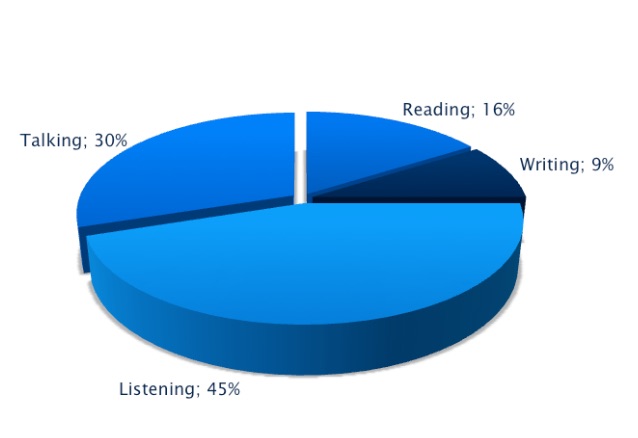
It’s all very well being effective in our approach to questioning but if we do not listen to what we are being told, the effectiveness of our questions is irrelevant and we are missing the opportunity to demonstrate interest and understanding of the person we are communicating with. There are four principal methods that we use to communicate (with the exception of non-verbal behaviour).
These are:
Listening is a skill, which is important in everything we do not just in helping us develop effective relationships. It is an important skill but unlike talking, reading and writing we are not taught how to listen. Although we spend a lot of time ‘hearing’, experts estimate that only 25-50% of this time is spent actually ‘listening’.
‘Hearing’ is a passive response, whilst ‘listening’ is an active action. Active listening is a simple technique which, when used in conjunction with effective questioning will help you, and those that you deal with become even more effective at reaching clearer understanding, thereby increasing your chances of achieving positive outcomes.
Have you ever spoken with someone who you know is not actually listening? Often people are ‘waiting to speak’ and not really listening to you at all. This is sometimes very obviously demonstrated, when someone speaks over you before you have even finished what you were saying for example.
So when we talk about active listening we mean that we are consciously listening for cues and clues as to what the actual message is and not making assumptions or trying to shortcut to an answer because of our own experiences or beliefs about what may be going on.
We can do this very simply by allowing the person to speak and then reflecting back to them what we think is the key message and following up with an open question to help get more information. We can also show that we are actively listening by using other forms of communication whilst the person is speaking: for example eye contact, nodding, by using affirming sounds or words (eg “uh-huh”, “I see”, “Yes, I understand”).
All these simple things communicate to the person speaking that we are listening to them and when we truly listen, then we can truly start to understand and when we understand we can do something to help, when we help we can be productive and more effective.
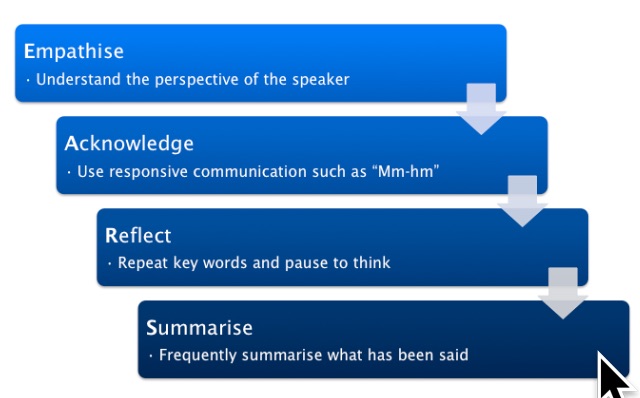
The EARS Listening Model
Reflection time
Reflect on your listening skills. How can you improve on them?
Twelve tips to improve your listening
These guidelines come from the book Clean Language, by Wendy Sullivan and Judy Rees.
- Put your attention on what the other person is actually saying rather than on the person themselves or what you think they might mean by their words.
- ‘Soft focus’ your eyes to take in the whole scene, rather than looking into the eyes of the other person.
- Give them time: don’t be impatient for your chance to talk.
- Set your personal agenda aside, at least temporarily.
- Visualise: mentally create your own model or diagram of what the other person is saying, but remember it is just that – yourdiagram or model, not theirs.
- Believe what the other person is saying. Treat the words as if they are literally true for the speaker.
- Repeat back some of their words or phrases exactly as you heard them.
- Take notes, if appropriate and it helps you pay attention.
- Know your best listening state.
- Turn your internal commentator down or off.
- Be curious.
- Practise!
Twelve more keys to effective listening in mentoring
- Be calm – the calmer you are, the more attentively you will listen and the more you will encourage the other person to talk openly.
- Adopt a posture that indicates to the other person that you are listening and which will stimulate you to feel in listening mode.
- Slowly tune out the rest of the world to focus on the other person. (If you start by expanding your awareness, it is often easier to focus in.)
- Suspend judgement – take an attitude of listening to understand rather than assess. Try to avoid drawing conclusions either about the person or the issue.
- Listen with your eyes and intuition as well as your ears: look for dissonance between what is said and what other senses tell you.
- Listen to the emotion and mood of what is said, as well as the content
- Let go of the need to speak and to make your own points, until you have listened to all there is.
- Listen for what is not
- Listen for patterns and themes – in the words people use, the images they evoke, the emotions they reveal.
- Do not feel obliged to keep asking questions: less is more.
- Allow space for silence; don’t feel obliged to fill the space.
- Don’t take notes – you can’t attend fully if you do. If you need to take notes, take short breaks in the conversation, where you can both jot down points to remember.
Thinking Time
Taken from the work of Nancy Kline – “Time to Think”
How many mentors know how to set free the human mind in front of them? How many are driven to find out how far mentees can think on their own before they need input from them? How comfortable are most mentors if the mentee never needs input?
Many of us are not comfortable with silence and look to fill it instead of allowing the mentee thinking time, to think for themselves and come to their own conclusion. A mentor should try to provide a “thinking environment”, where the mentee’s thinking comes first. Here are some pointers for providing this thinking environment:
- Pay unbelievably beautiful attention to the thinker. Listen with respect, interest and curiosity.
- Keep your eyes on their face; don’t look away.
- Look interested; or rather, be interested.
- Make sounds to indicate understanding or encouragement only occasionally.
- Be at ease: nothing horrible is about to happen.
- Smile occasionally, when it won’t be interpreted as derision.
- Don’t even think about interrupting.
- Don’t ask picky clarifying or confirming questions.
- When your partner has nothing more to say, ask, ‘What more do you think or feel or want to say about this?’
- Again, do not even think of interrupting them.
- If the thinker becomes quiet, but their eyes are alive, relax and stay quiet: they’re thinking.
Thinking time
Practice some of the features listed above in ‘Time to think’. Reflect on how it felt, and how you can improve next time.


Leave a Reply
Want to join the discussion?Feel free to contribute!